
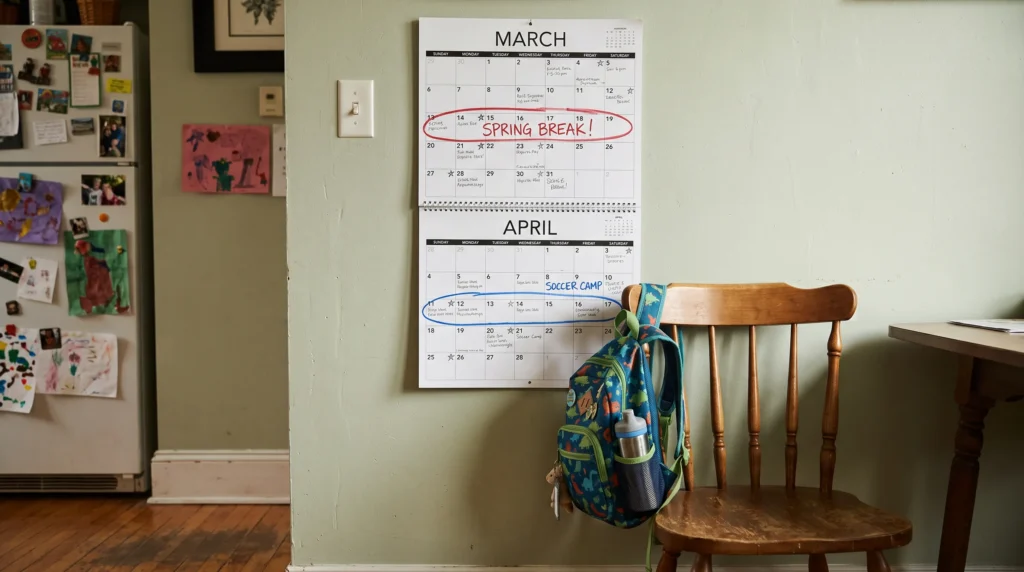
Your parenting plan says “spring break alternates each year.” Simple, right? Then one child is in San Marcos Unified and the other is in Carlsbad, and their breaks fall a week apart. Suddenly nobody knows whose week it is, the grandparents booked flights for the wrong dates, and you’re arguing over text again. I see this every spring in blended and split households. Here’s why the usual clause fails, and how to rewrite it so both calendars actually work.
Why “Alternating Spring Break” Breaks Down in North County
Most parenting plans were written when the kids were small, lived in one home, and went to one school. Life rarely stays that tidy. One parent moves from Vista to Encinitas. A stepchild joins the family. A teenager transfers to a different high school. Now the plan points to “spring break” as if there’s only one.
When Two Districts Mean Two Different Spring Breaks
North County districts don’t all take the same week off. For the 2026 to 2027 school year, published calendars show San Marcos Unified’s spring recess running from March 29 to April 2, 2027, while Carlsbad Unified and Oceanside Unified both list April 5 to 9. That’s two separate weeks for families split across those districts.
So “spring break” can mean two different weeks in the same family. Each parent reads the plan in the way that suits their own schedule, and honestly, both readings can sound reasonable. That’s how a vague clause turns into a real fight.
And the calendars aren’t fixed forever. Districts set them a year at a time, and dates can move. A plan that hard-codes “the first week of April” will be wrong sooner or later. That’s another reason to tie the clause to each school’s published calendar rather than a specific week.
The Ripple Effect on Holidays, Travel and Work
The problem doesn’t stay with one week. If one parent takes the San Marcos week and the other takes the Carlsbad week, the regular schedule gets shifted for almost a month. Easter weekend might land on top of it. Work vacation requests, flights, summer camp deposits and childcare all start depending on a date nobody agreed on.
And kids feel it. A child who spends two spring breaks in a row away from a sibling, or who misses a family trip because of a calendar mix-up, notices. They don’t care whose turn it technically was. They just know the grown-ups were fighting again.
Why Easter and Spring Holidays Make It Messier
Many plans also have a separate holiday rotation for Easter, Passover or other spring holidays. When those fall inside one district’s break but not the other’s, the plan can point in two directions at once. One clause says it’s Dad’s spring break. Another says it’s Mom’s Easter. Both parents are reading the plan correctly, and they still end up in conflict.
The fix is a simple priority rule. For example: “If a holiday falls during spring break, the holiday schedule controls for that day, then the spring break schedule resumes.” One sentence like that ends a lot of arguments.

How to Write a Spring Break Clause That Fits Two Calendars
The fix isn’t to argue harder about what the old clause meant. It’s to write a new one that names each child’s calendar directly. Here are the three approaches I see work best.
Tie the Schedule to Each Child’s District Calendar
Instead of “spring break,” name the school. For example: “Each child’s spring break follows the published calendar of the school that child attends. In odd years, Parent A has the first half of each child’s break and Parent B has the second half.” This way, the plan updates itself when a child changes schools, and nobody has to guess.
Some families prefer to keep siblings together. In that case, the clause might say the kids spend the overlapping days together with one parent, and the non-overlapping days follow each child’s regular schedule.
Decide Whether Siblings Travel Together
This is the real question underneath most spring break fights. Do you want the kids together, or is it fine if they’re with different parents for part of the week?
If keeping them together matters most, you may pick one “family spring break week,” usually the one that covers the most days off for both kids, and accept that one child misses a few school days or spends a few days in the regular routine. If flexibility matters more, splitting by child can work fine. Neither choice is wrong. It just needs to be a choice you both made, written into the plan.
For blended households where stepsiblings are also on different calendars, this gets layered fast. Our blended family mediation helps sort out how all the kids’ schedules fit together, not just one set of siblings.
Build in a Notice Date for Travel Plans
Most spring break fights start because one parent books something before the other knows. A simple fix is a notice deadline. For example: “Each parent will share any travel plans for spring break, including dates and destination, by February 1.” That gives both parents time to adjust and keeps a surprise flight from becoming an emergency.
You can also add a rule for passports and out-of-state travel, like how much notice is needed and who holds the documents. These details sound small until the week before a trip.
Add a Simple Tie-Breaker for Surprises
No clause predicts everything. A school adds a make-up day. A district shifts its break. A child’s sports team has a tournament that week. Build in a tie-breaker so you don’t have to start from scratch each time.
That might be “if we can’t agree within 14 days, we’ll schedule a short mediation session before booking any travel.” Or “if the break dates change, the parent who had the original week keeps the same number of days on the new dates.” It doesn’t need to be fancy. It just needs to exist, so a surprise becomes a quick fix instead of a fight.

When It’s Time to Update Your Parenting Plan
A parenting plan isn’t meant to last forever unchanged. Kids grow, families move, and schools change. If you’re reading this in February and already feeling the tension rising, that’s your sign.
Signs Your Current Plan Has Stopped Working
Here are the patterns I hear most often from parents who need an update:
You’re texting about “what the plan really means” more than once a season.
Your kids are in different schools, or one changed schools since the plan was written.
New partners or stepchildren have joined one or both households.
One parent moved, and drive times changed how handoffs work.
Holidays and school breaks are handled by last-minute deals instead of clear rules.
If two or more of these sound familiar, your plan probably needs more than a one-time compromise. It needs new language.
What an Update Session Covers
When we work on a plan update through parenting plan development, we don’t start from scratch. We look at what’s working, keep it, and fix what isn’t. A typical update covers school breaks by child and district, holiday rotations, travel notice and passport rules, and how you’ll handle the next school change.
Most updates are focused and fairly quick, because you’re adjusting specific sections rather than rebuilding the whole plan. We can meet on Zoom, which helps when parents live in different parts of North County, or in person. If your plan is part of a court order, we’ll also talk about how the updated agreement can be submitted, so the new terms carry the same weight as the old ones.
If you and your co-parent mostly get along but keep hitting the same calendar snags, co-parenting mediation gives you a calm place to work through it before the next break arrives.
Start Before the Calendar Starts Pushing You
The best time to fix a spring break clause is not the week before spring break. It’s now, while there’s time to talk without a deadline looming. February is when flights get booked, camps open registration, and work vacation requests are due. A plan that’s settled by then saves everyone a stressful March.

It’s also easier on the kids. When they know in January where they’ll be for spring break, they can look forward to it instead of bracing for another argument. Older kids especially notice when plans keep changing, and some start to feel responsible for the conflict. A settled plan takes that weight off them.
Two Calendars, One Plan That Works
Your kids shouldn’t have to carry the stress of a vague sentence in a court document. When the plan names each child’s calendar, sets a travel notice date, and answers whether siblings stay together, spring break stops being a yearly negotiation. It becomes just another week on the calendar that everyone understands. If your family now spans two school districts, the old clause wasn’t written for the life you’re living. A short update now can save you a lot of arguing every spring after this one.
Update Your Plan Before Spring Break
Want a spring break schedule that fits both school calendars? Book a free consultation with Common Ground Mediation and we’ll talk through what your updated plan could look like.